


Case Study: Forde Abbey, Dorset
Patrick Stow of P J STOW & ASSOCIATES was commissioned by the house owner to investigate the condition of the Ham stone portico, report on the findings and devise a
means of repair and so the Cintec system was an obvious choice.
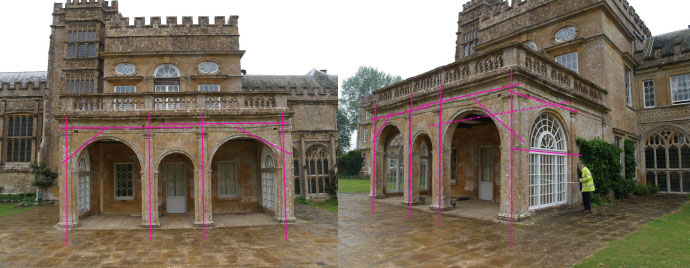 Such an historically important building as Forde Abbey requires particular care and careful attention to detail. Such was the magnificence of the portico and with a wonderful patina on the surface of the masonry that the engineer wrote a very “tight” specification for the structural stabilization works.
The distortion of the portico can be clearly seen in the above photograph and in the survey drawings below . The portico when built, did not have the three open arches to the front as illustrated in an early view of the building in the engraving below. So by reforming and altering the original configuration of the structure it was de-stabilised some considerable time.
Patrick Stow’s report recommended inspection of the structure with Cintec which revealed that there were several avenues for the insertion of concealed expanding grout sock anchors which would provide very substantial strengthening measures to overcome the structural flaws now present. Subsequent discussions with English Heritage (now Historic England) determined that the Cintec option was the most acceptable solution in conservation terms and approvals were readily forthcoming for this scheme.
Essentially the structure would be fixed or stitched in its current deflected form, whilst introducing tension reinforcement to relieve the arches of as much lateral tension springing forces as possible. The solution was to insert anchors within the masonry to create an invisible internal reinforced concrete frame to tie the various elements together thereby preventing further movement and preventing a collapse of this important building.
All the holes to receive the anchors were created using water cooled diamond core drills affixed to drilling rigs, bolted to rigid scaffolding to ensure accuracy of line and level. The drills used were mining barrels which ensure accuracy of direction over long lengths and keep holes open and free from debris. The anchor is then carefully inserted into the pre-drilled hole, with the sock evenly distributed along the full length of the anchor without any “bunching”, to the correct depth
and with the front end recessed from the face of the wall. This is to permit replacement of the retained core of stone which has been kept when drilling.
Once the grout has set the projecting ends of the feed tubes are removed and the stone mason is able to replace the cores which have previously set aside. The end result is a virtually invisible repair plus a longevity of life for the building in a stable condition.