


Case Study: Lincoln Cathedral conservation & repair of the west front
The west front of Lincoln Cathedral is famous for its 12th century carved frieze which runs right across the facade from the northern corner of the west front around the southern corner, to the southern side of the building. The frieze consists of a series of panels, each a little more than one metre high and varying in width, on which scenes have been carved showing scenes from Heaven and Hell and conveying messages from both the Old and the New Testament.
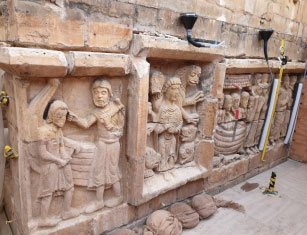 Romanesque Frieze
Assessment by the Cathedral Works Department Conservation Team confirmed that panels within the southern run of the Romanesque Frieze are likely to be subjected to vertical loading applied from the ashlar stonework of the elevation above. Panel 15 exhibited cracking and movement indicative of the panel being under vertical load.
Structural engineers Ramboll working in conjunction with the Cathedral team and conservation architects arrived at a solution to support the outer face of masonry immediately above the string course locally via installing discrete metal brackets, which are secured back to the core of the wall with Cintec anchors.
Metal support angles were secured to the fabric with large diameter Cintec anchors, which have an ability to “corbel” forward, and transfer the load applied back into what could be a core of variable integrity.
If the material exposed is very poor, a separate phase of pressure grouting can be completed to improve the nature of the material locally, and then the Cintec anchors would be installed.
Natural arching supports the masonry loads in between the supporting metalwork and by jacking between the underside of the stone course above and the projecting metalwork, the integrity of the installed metalwork was confirmed.