


Case Study: North Or Red Pyramid At Dahshar, Cairo
 The pyramid gets its name from the reddish limestone used to build most of the core. Like all the other pyramids the outer casing of Tura limestone has been removed in
antiquity. This pyramid was built for the Pharaoh Senefru in 2575 B.C. The previous two attempts at building pyramids known as Meidum pyramid and the Bent pyramid had failed due to structural problems. Although, the Red pyramid has the same base size as the other pyramids, the angle of the slope is only 43 degrees, which probably, accounts for the speed needed to construct the pyramid before the Pharaoh’s death.
Senefru would become the greatest pyramid builder in Egyptian history by constructing these colossal pyramids. Together with his son and grandson, who built the two great pyramids at Giza, he was responsible for constructing the largest volume of stone pyramids in the world.
The Problem
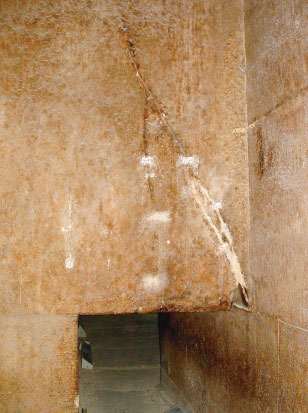
 The present problem was not on the exterior of the pyramid but on the corridor between the corbelled burial chambers. The beams spanning the low corridor opening were cracked, from the base of the stone beams, up through the centre of the beams, to a position just adjacent to the centre at the top of these stone beams.
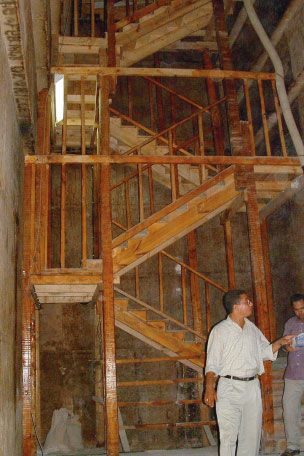
It was impossible to drill at right angles to the corridor, due to the mass of the core of the pyramid. However, it was possible to drill at an angle of 43 degrees in the respective burial chambers at both the entrance and exit of the corridor and secure the beam with a row of 20mm diameter Cintec stainless steel consolidation anchors. Work was completed at night after the monument was closed to the public. The position of the burial chamber being some 60 metres down a 45 degree slope made it
necessary for the operatives to use a dust extraction unit and breathing apparatus.