


Case Study: Pont Cilan, Llandrillo
Pont Cilan is a two span masonry arch bridge with a clear north span of 11.72m, a clear south span of 11.88m. The arches and the central pier are constructed from random rubble masonry.
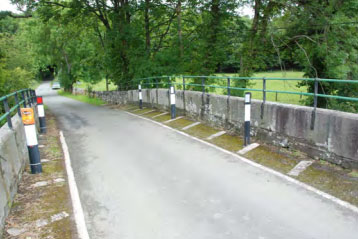 The Grade 2 listed structure is described by Thomas Pennant in 1781 as ‘a bridge of 2 arches over a deep and black water’. The SE abutment may be earlier. The roadway was widened, probably in the C19, to provide walkways, and the parapets were corbelled out and rebuilt.
The bridge carries the carriageway over the River Dee approximately 1.5km north west of Llandrillo village. It is also a Scheduled Ancient Monument ME032.
Denbighshire County Council approached Cintec as the company had carried out a major project on another listed bridge in the county in previous years as Pont Telpyn which subsequently won an award for conservation.
A report on Pont Cilan carried out for Denbighshire stated: The cantilever deck extensions have partially failed and are in poor condition. They have therefore been qualatively assessed as having zero capacity.
Furthermore the wrought iron frames supporting the cantilever extensions are of very lightweight construction and badly distorted and cannot be relied upon. The cantilever extensions remain vulnerable to accidental wheel loading. As the structure is listed any proposals to strengthen them will have to be agreed with CADW.
Cintec engaged structural engineers Epoc to carry out a survey, analysis and design to strengthen the existing cantilever and ensuring that no change to the physical appearance of the bridge.
The scheme consisted of overlapping horizontal Cintec anchors installed from both sides of the bridge through the face of the existing cantilever stones ensuring that each stone was anchored.
Each anchor has an unsocked length at the centre of the bridge which would subsequently be embedded in concrete overlaid with a layer of mesh reinforcement.
Diamond core drilling was used to create the 82 holes 65mm diameter to receive the 3.00m long Cintec 20mm stainless steel anchors.
Cores of the stone were retained for replacement upon completion to conceal the completed fixings.