


Case Study: World Heritage Site Blaenavon Iron Works, South Wales
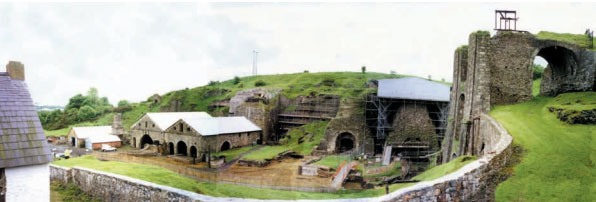 The furnaces at Blaenavon were built in 1788-89 and remained operative until the ironworks eventually closed in the 1880’s. Understandably, the site was not then attributed the historical importance with which it is now held, and much of the masonry was taken away and used to build a local church. The remaining structures were
left in a precarious state of repair and the responsibility for their conservation has fallen to Cadw – the national body responsible for the restoration of historic monuments in Wales.
The remaining furnaces required consolidation. In the first phase of this long term and ongoing project, a series of Cintec anchors were installed to support the delicate structures and so enable more extensive repairs and refurbishment to proceed. Working in very difficult conditions, data was acquired so that 3D models could then be generated to facilitate the accurate positioning of the strengthening anchors.
Cintec anchors
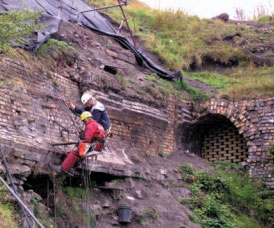 Conservation of Blaenavon Ironworks in South Wales continues to rely on Cintec anchors to solve the problem of stabilising walls of unknown and inconsistent structure.
The 2003/4 phase of conservation of this historical industrial site involves both the stabilising of retaining walls and the strengthening of an adjacent Gas Tunnel built into the hillside behind the site’s five furnaces.
The cylindrical brick gas tunnel in Work Area 2 runs behind the furnace bank wall at a height of about 10 metres from the ground. An old collapse of a section of the wall left the broken remains of part of the tunnel in a precarious state on the steep slope. The tunnel was originally supported on iron plates and cylindrical bars spanning onto stone masonry walls. However with much of the outer support wall now missing, the tunnel was left with little obvious support and was unsafe to access from below.
The first stage of conservation involved the installation of Cintec anchors through the brickwork of the tunnel into stone masonry and the embankment behind, to support the weight of the tunnel. The anchoring operation allows safe access to be achieved from below, for the rebuilding of the support masonry. The instability of the remains precluded access from below, and roped access from above was the specified method of installation.
The exact composition of the tunnel remnants and interfacing wall structures was unknown. Initial drilling of cores for the anchors confirmed that the 200+ year old structures were riddled with voids and an inconsistent mix of stone masonry, clay and coal. The fully encapsulated design of the Cintec system offered the most efficient way of stabilising these wall conditions. By containing the grout, the Cintec sock ensures none is lost and there is no undesirable migration into other parts of the structure. An optimum amount of grout is taken up into the sock in achieving a sound, continuously embedded structural solution in the wall, regardless of voids. This effectively binds together all of the various materials penetrated, resulting in good cohesion and consolidation.
Double mining barrel
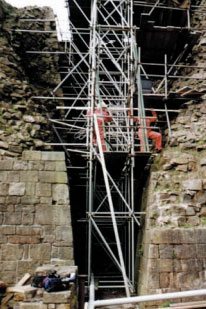 A double mining barrel, with an inner and outer sleeve, was used in areas where drilled cores could collapse before reinforcing members could be introduced due to the instability of the wall materials. The outer sleeve then creates a rigid conduit for the inner sleeve to work through, allowing core to be extracted to the required depth. With the outer sleeve still in place, the inner sleeve is removed and the Cintec anchor system inserted. The outer sleeve is then withdrawn before the anchor is permanently bonded into position with injection of grout into the Cintec sock.
A total of 29 deformed round bar stainless steel anchors, measuring 20mm diameter and 4m long, were used in this stage of conservation. A further combination of 8m long consolidating stitching anchors, 30mm by 30mm by 3mm SHS (square hollow section), and ground anchors approximately 11m long, were also used near the water tower.
The Cintec system is approved by The National Trust, English Heritage and Cadw for the restoration of all types of listed and protected structures.